
Community Description
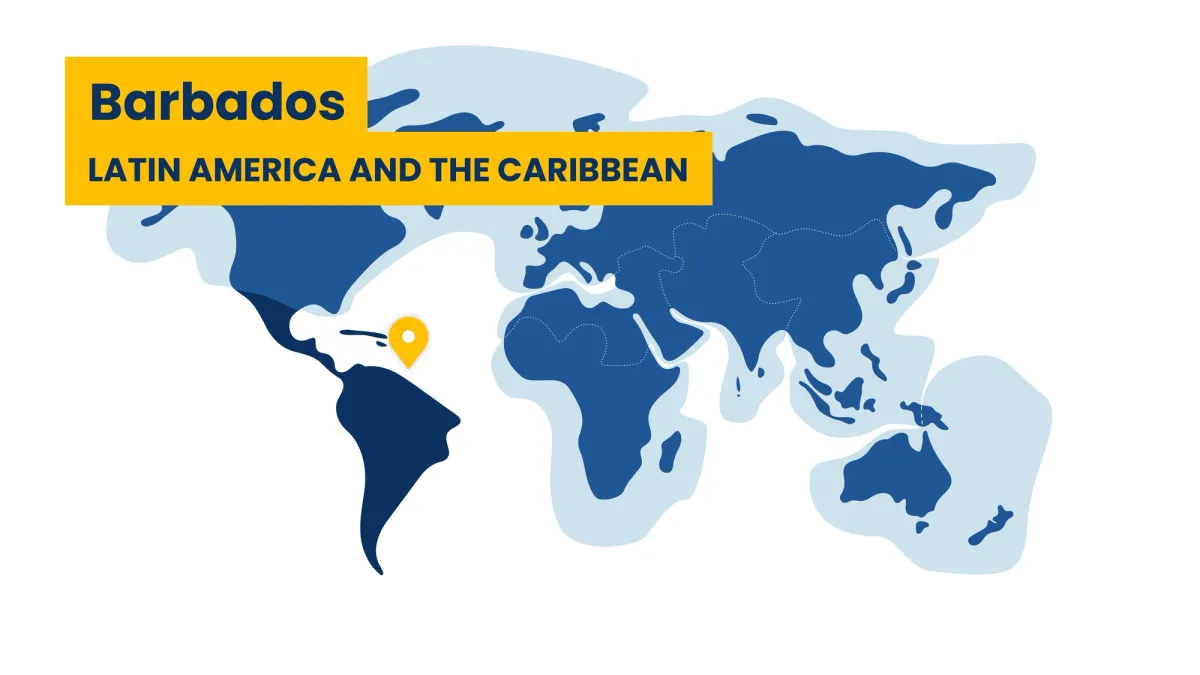
The small island developing state of Barbados is located in the eastern Caribbean with a population of approximately 282,000 and a total land area of 166 mi2. Economic activity on the island is dominated by the service sector, especially tourism and financial services (Michigan State University, 2024). Although Barbados is classified as high-income with a high level of human development, the country is vulnerable to multiple dimensions of climate threat, including acute weather events, rising sea levels, ocean acidification, beach erosion, and water scarcity (Leal Filho et al., 2021; USAID 2021; UNDP 2021). Compared to other climate-related effects, water scarcity is relatively unacknowledged; therefore, in this case study we seek to describe water challenges in Barbados, mental health impacts, and multifaceted responses to illustrate adaptations to water scarcity.
Water Scarcity in Barbados
Barbados relies almost entirely on groundwater, with 82% of its water supply sourced from aquifers and the remaining 18% from brackish water desalination. The estimated renewable water resources per capita per year in Barbados stand at 279 m3. Falling below the threshold of 500 m3 per capita per year categorises Barbados as experiencing absolute water scarcity using the Falkenmark index (Falkenmark et al., 1989). Barbados experiences both looding and drought, which are likely to increase as a function of climate change (Climate Studies Group Mona, 2020). Moreover, climate projections indicate a drying trend of approximately 6% by 2050, as well as sea level rise in the range of 0.17-0.38 m for 2046 – 2065 (Climate Studies Group Mona, 2020). The cumulative effect will be water quality degradation due to saline intrusion and more pronounced declines in groundwater levels. Security of groundwater-reliant supply is further compromised by faltering infrastructure, management challenges, and rising costs (Cashman, 2017).
The issue of water shortages is particularly acute in the island’s northern parishes, where residents are faced with salty and turbid water for drinking and washing. In many instances, water tankers are deployed to provide reprieve from disruptions of water service.
Residents collecting water from Government-supplied potable water tankers (Photo courtesy of Nation Publishing)
Climate-Related Mental Health Impacts
The psychological implications of inadequate access to fresh water for drinking and washing are less researched than the more obvious deleterious effects on physical health, but evidence is emerging. A recent review organised findings on stressors related to water scarcity using a framework developed by Wutich, Brewis, and Tsai (2021). Expectedly, lack of drinking water itself is a key stressor, but components impacting wellbeing are broader and more complex, including material deprivation, physical health stressors, shame and guilt, lost opportunities, and, importantly, experience of inequalities across space and socioeconomic status (Toivettula et al., 2023).
Understanding of the causal relationships of water scarcity to specific mental health outcomes is still developing, but existing research has demonstrated associations between water scarcity (and the related problem of poor sanitation) and common mental disorders (Kimutai et al., 2023). For example, a study in Uganda (Cooper-Vince et al., 2018), reported that people in water-scarce areas were more likely to experience depression and that the risk was greater for women than men. A study in Haiti (Brewis, Choudhary, & Wutich, 2019) found that water insecurity had a strong independent effect on levels of both anxiety and depression. Further, water insecurity contributed to anxiety through its effect on access to elements of basic sanitation such as working toilets. It is important to remember that larger-scale public health trends are reflected in the lived experience of people, illustrated in a small number of evocative qualitative studies. Among these are work by Choudhary and colleagues (2023) exploring loss of dignity, frustration, and anger among Indian women coping with menstruation in water-scarce communities.
Lived Experiences
The anxiety, frustration, and fear resulting from the impact of inadequate water supply on basic activities of daily living and economic livelihood have been captured in the national media (Barbados Today 2019). The Government’s responses to alleviate this distress have also been covered by the media (Barbados Today 2024; Clarke, 2022). However, the current public narrative may not adequately reflect resilience among Barbadian youth.
Mr. Nicholas Bedford, a teacher at the Barbados Seventh-day Adventist (SDA) Secondary School is aware of the challenges faced by Barbadians facing water scarcity but also has insight into the work being done by youth to safeguard water access on the island. Over the past five months (September 2023-February 2024), Mr. Bedford has been shepherding a group of seven students, ages 14-16, who are conceptualising, designing, and implementing an innovation project to address water scarcity on the island. The group has analysed the various water networks and is applying techniques drawn from physical, chemical, and environmental sciences to convert surface water to potable water. The student project is under the auspices of the Future Forward Initiative, which is currently working with students across several secondary schools on the island to create innovations aligned to the UN Sustainable Development Goals. Both Mr. Bradford and Ms. Nicole Bourne, head of the Department of Math and Science, were quick to see the value of this programme for their students and have supported the collaboration.
Mr Bedford describes several benefits of the project and the growth that he has seen in students engaged in this work. In addition to applying scientific concepts to potential water solutions, students have been able to connect SDGs to daily life. He has seen students increase their confidence in asking questions and questioning assumptions, including in grappling with challenging policy issues such as inequities in access to water and balancing public and commercial interests.
Mr. Nicholas Bedford, Head of Department of Technical and Vocational Education, The Barbados Seventh-day Adventist Secondary School
Responses to Climate-Related Psychosocial Stressors
The government of Barbados is currently implementing supply enhancement strategies to address water scarcity challenges and build more climate-resilient strategies within the water sector. Initiatives include the replacement of aged infrastructure to reduce the level of leakage and wider adoption of rainwater harvesting systems. Soon-to-be-introduced water reclamation for agricultural use will treat wastewater to tertiary standards at the Bridgetown treatment plant. Using treated water for agriculture will reduce stress on diminishing groundwater resources. These projects are financed by the Green Climate Fund through the Caribbean Community Climate Change Centre (CCCCC, 2024).
Further, the Ministry of Health and Wellness has built capacity for psychosocial support by providing community-based psychological first aid (PFA) training funded by the Pan American Health Organisation (PAHO) to clinicians, teachers, first responders, government employees, church groups, and community organisations (Douglin et al., 2024). Strengthening the ability to provide mental health support in the community is integral to whole-of-society response to climate-related crises and disasters, including disruptions to essential services.
Residents using Government-provided communal water storage for washing (Photo courtesy of Nation Publishing)
Key Insights, Lessons Learned and recommendation
The water scarcity challenges in Barbados reflect a multi-dimensional problem that illustrates the intersections between climate mental health and the socioeconomic contexts in which climate events occur. This case study offers examples of government- and NGO-led initiatives to mitigate the lived stressors related to inability to access reliable supplies of potable water. This case study illustrates how the creativity, critical application of knowledge, and commitment of youth can catalyse community responses to climate change. Further research is needed to address the social inequalities that differential water scarcity both evidences and exacerbates, as well to support the mental health of people and communities confronting water insecurity.
Gentleman awaiting water support (Photo courtesy Nation News)
References
Brewis, A., Choudhary, N., & Wutich, A. (2019). Household water insecurity may influence common mental disorders directly and indirectly through multiple pathways: Evidence from Haiti. Social Science & Medicine, 238,112520. https://doi.org/10.1016/j.socscimed.2019.112520
Caribbean Community Climate Change Centre (CCCCC). (2024, February). 3RCrews project for Barbados. https://www.caribbeanclimate.bz/gcf/2022/09/13/3r-crews/
Cashman, A. (2014). Water security and services in the Caribbean. Water, 6(5), 1187-1203. https://doi.org/10.3390/w6051187
Choudhary, N., SturtzSreetharan, C., Trainer, S., Brewis, A., Wutich, A., Clancy, K., Fatima, U. A., & Jobayer Hossain, M. (2023). Managing menstruation with dignity: Worries, stress and mental health in two water-scarce urban communities in India. Global Public Health, 18(1), 2233996. https://doi.org/10.1080/17441692.2023.2233996
Clarke, S. (2022, February). Move to ease water woes in St Lucy. Nation News. https://nationnews.com/2022/02/17/move-ease-water-woes-st-lucy/
Climate Studies Group Mona (Eds.). (2020). The State of the Caribbean Climate. Caribbean Development Bank.
https://www.caribank.org/sites/default/files/publication-resources/The%20State%20of%20the%20Caribbean%20Climate%20Report.pdf
Cooper-Vince, C. E., Arachy, H., Kakuhikire, B., Vořechovská, D., Mushavi, R. C., Baguma, C., ... & Tsai, A. C. (2018). Water insecurity and gendered risk for depression in rural Uganda: a hotspot analysis. BMC Public Health, 18, 1-9. https://doi.org/10.1186/s12889-018-6043-z
Day, M., & Day, P. (2017). Barbados. Landscapes and Landforms of the Lesser Antilles, 209-221. https://doi.org/10.1007/978-3-319-55787-8_14
Douglin, K. K., Campbell, M. H., Emmanuel, M. K., Harewood, H., Forde-St. Hill, K., & Quimby, K. R. (in press). Assessing need and readiness for a post-disaster psychological first aid course in Barbados. Forthcoming in World Cultural Psychiatry Research Review.
Falkenmark, M., Lundqvist, J., Widstrand, C. (1989). Macro-scale water scarcity requires micro-scale approaches. Natural Resources Forum, 13, 258–267. https://doi.org/10.1111/j.1477-8947.1989.tb00348.x
Leal Filho, W., Krishnapillai, M., Sidsaph, H., Nagy, G. J., Luetz, J. M., Dyer, J., ... & Azadi, H. (2021). Climate change adaptation on small island states: An assessment of limits and constraints. Journal of Marine Science and Engineering, 9(6), 602. https://doi.org/10.3390/jmse9060602
Kimutai, J. J., Lund, C., Moturi, W. N., Shewangizaw, S., Feyasa, M., & Hanlon, C. (2023). Evidence on the links between water insecurity, inadequate sanitation and mental health: A systematic review and meta-analysis. Plos One, 18(5), e0286146. https://doi.org/10.1371/journal.pone.0286146
Michigan State University. (2024, February). Barbados. In globalEdge. Michigan State University. https://globaledge.msu.edu/countries/barbados
PM: Tackling water scarcity a priority - Barbados Today (2024, February 1). Barbados Today. https://barbadostoday.bb/2024/02/01/pm-tackling-water-scarcity-a-priority/
Toivettula, A., Varis, O., Vahala, R., & Juvakoski, A. (2023). Making waves: Mental health impacts of inadequate drinking water services—From sidenote to research focus. Water Research, 120335. https://doi.org/10.1016/j.watres.2023.120335
United Nations Development Programme (UNDP). Barbados. Data Futures Exchange. https://data.undp.org/countries-and-territories/BRB
United States Agency for International Development (USAID). (2021). Climate Risk Profile: Eastern and Southern Caribbean. https://www.climatelinks.org/sites/default/files/asset/document/2021-10/ESC%20Climate%20Risk%20Profile%20-508.pdf
Venkataramanan, V., Collins, S. M., Clark, K. A., Yeam, J., Nowakowski, V. G., & Young, S. L. (2020). Coping strategies for individual and household‐level water insecurity: a systematic review. Wiley Interdisciplinary Reviews: Water, 7(5), e1477. https://doi.org/10.1002/wat2.1477
Water scarce. (2019, August 22). Barbados Today. https://barbadostoday.bb/2019/08/22/water-scarce/
Wutich, A., Brewis, A., & Tsai, A. (2020). Water and mental health. Wiley Interdisciplinary Reviews: Water, 7(5), e1461. https://doi.org/10.1002/wat2.1461
Written by
Michael H. Campbell
Senior Lecturer in Behavioural Science/ Psychology
Faculty of Medical Sciences
The University of the West Indies, Cave Hill, Barbados
Karl Payne
Lecturer in Water Resource Management
Centre for Resource Management and Environmental Studies
The University of the West Indies, Cave Hill, Barbados
Natalie Greaves
Lecturer in Public Health
Faculty of Medical Sciences
The University of the West Indies, Cave Hill, Barbados
Corresponding author: michael.campbell@cavehill.uwi.edu