
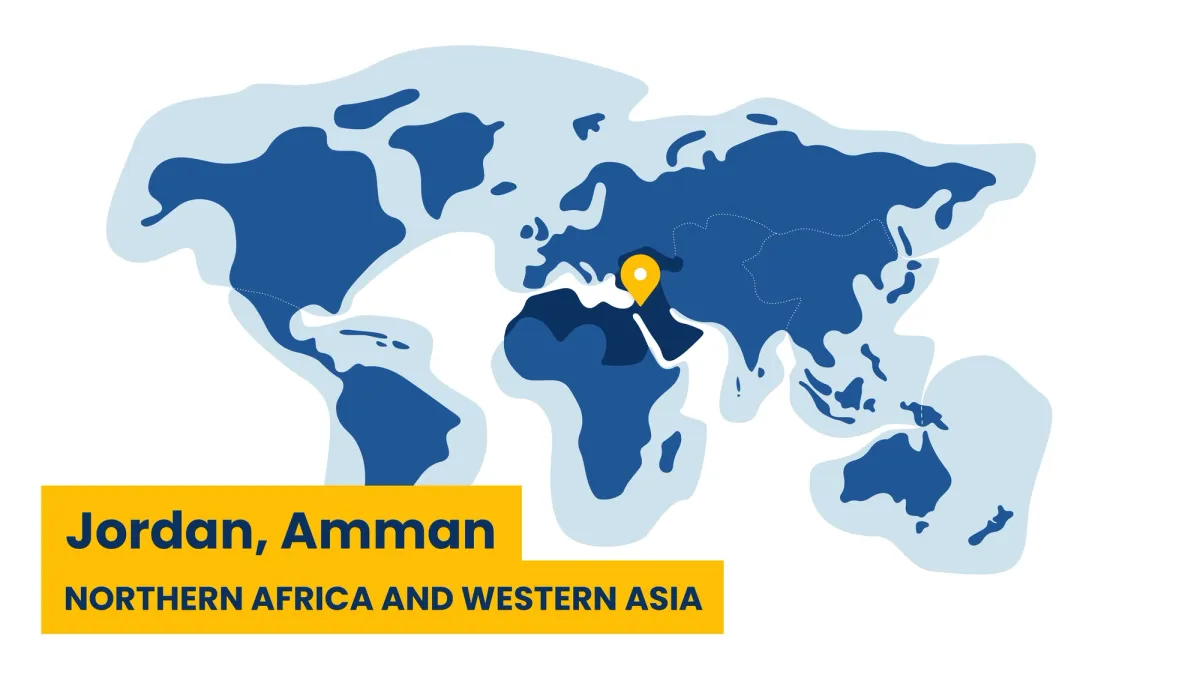
Brief Description of the Community/Country and Climate Change Experience
Dr. Yaroup Al-Ajlouni, President of the Jordan Health Aid Society, present the findings of the Connecting Climate Minds dialogue on climate change and mental health at the Ministry of Health of Jordan. (Photo courtsey of Jordan Health Aid Society)
Jordan, a country in the Middle East, is grappling with the escalating impacts of climate change characterized by arid and semi-arid climates. Jordan faces significant environmental challenges, including water scarcity, rising temperatures, frequent droughts and reduced agricultural productivity. More specifically, Jordan ranks amongst the lowest countries globally for water availability. Historically, Jordan's economy and population have been heavily influenced by regional instability and the influx of refugees, further exacerbating its environmental vulnerabilities. (WHO, 2015)
The mental health impacts of climate change in Jordan are profound and multifaceted. Reports indicate increased incidences of anxiety, depression, and stress-related disorders, particularly among vulnerable populations such as refugees. Epidemiological studies, though limited, suggest a correlation between climate stressors and mental health issues (Al-Baz H, 2021). Anecdotes from local communities describe a sense of helplessness and despair due to the loss of livelihoods and the changing environment, illustrating the deep psychological impact of these climate challenges.
Policy Description
In response to the escalating impacts of climate change on mental health, Jordan Health Aid Society International (JHASi) has led a groundbreaking policy initiative. Aligning with Sustainable Development Goals 3 and 13, this initiative is dedicated to integrating the mental health consequences of climate change into the national health planning and services of Jordan. The genesis of the policy is traced back to JHASi's proactive involvement in the Connecting Climate Minds (CCM) project and leadership of the regional community of North Africa and Western Asia. Together with the global CCM team and regional partners, JHASi developed a regional research and action agenda on climate and mental health by organising a set of dialogues and consultations with input from the mental health and climate expert communities and those with lived experience of climate change. This engagement laid the foundation for a policy that aims to address these interlinked challenges.
At its core, the policy objectives are to acknowledge and address the mental health impacts driven by climate change within Jordan's national health policies. Key measures include incorporating discussions about climate and mental health into dialogues with donors, UN agencies, and governmental partners, thereby mainstreaming the issue into broader health and environmental discourse. Furthermore, JHASi has been instrumental in introducing climate and health topics to the Ministry of Health, emphasizing the need for these issues to be considered in the ministry's policies and planning. This approach signifies a paradigm shift, recognizing that climate change is not merely an environmental issue but a pressing public health concern, with tangible impacts on mental health and well-being.
This policy represents a collaborative effort, involving various actors such as the Ministry of Health, UN agencies, and non-governmental organisations such as the Royal Health Awareness Society and UNFPA. It targets all segments of the Jordanian population, with particular attention to vulnerable groups, who are most affected by the mental health impacts of climate change. Through this policy, JHASi has not only raised awareness of the climate and mental health nexus but also catalyzed the integration of climate-related mental health considerations into national health strategies and adaptation plans, marking a significant stride in addressing the psychological dimensions of climate change.
Current Impact
Since its implementation, the policy has raised awareness among health service providers and policymakers about the mental health impacts of climate change. It has led to the inclusion of mental health considerations in the national health strategy and adaptation plans in Jordan. However, measuring the direct impact on communities and the interventions needed to respond to and mitigate climate-related mental health impacts, is an ongoing process.
Challenges and Successes
Implementing the policy faced several obstacles including limited resources, insufficient data on climate-related mental health impacts in the region, and the need for broader stakeholder engagement and political will. Successes include effective collaboration between different sectors and the integration of mental health into climate change discourse at the national level.
Insights and Lessons Learned
This case study highlights the importance of multi-sectoral collaboration in addressing complex issues such as climate change and mental health. The approach can inform policies at both local and national levels, emphasizing the need for inclusive and evidence-based policymaking. The generalizability of this policy to other communities, especially in similar climatic and socio-economic contexts, is promising but requires context-specific adaptation.
Recommendations
At the national level, we call on researchers and research institutions to strengthen data collection and research on the nexus between climate change and mental health. Additionally, we call on governments and funding institutions to increase funding, budget allocation and resource mobilisation for mental health and psychosocial support services that anticipate, detect and respond to climate-related mental health impacts. It is essential to integrate mental health into climate adaptation and mitigation policies and vice versa.
Written by
Jordan Health Aid Society